Aqueous Coating for Food Packaging
Want an alternative to polyethylene (PE) coated paper and paperboard? Replacements for poly exist in food packaging. The answer is simple, FDA direct food compliant water-based (aqueous) coatings, supplied by Cork Industries are providing a proven alternative to PE coated paper and paperboard. Poly Replacement in Food Packaging can be our Aqueous coatings. These are formulated across a broad spectrum of desired properties that are often packaged product specific.
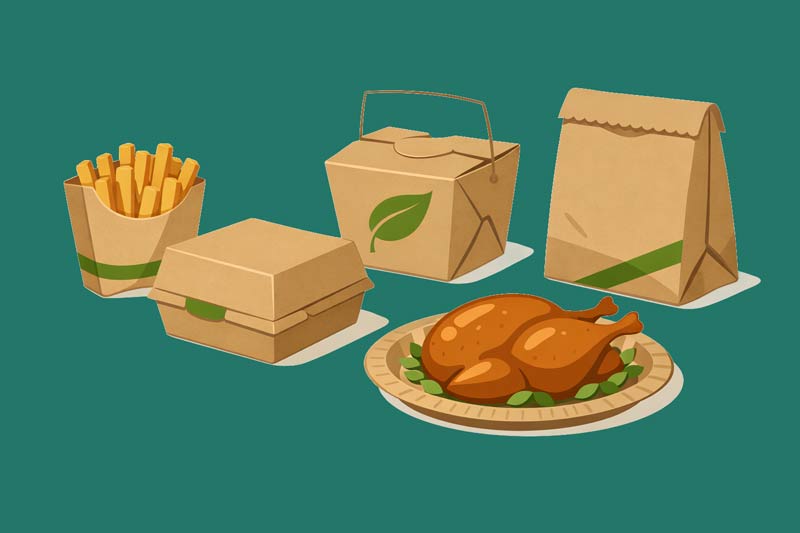
For example, Cork’s Aqueous Coatings are commonly used for fast food carryout packaging, (i.e., such products as French fries, onion rings, burgers, various sandwiches, fried chicken, and Asian takeout foods.) Other poly replacements in food packaging products include items such as bakery, pastries, frozen foods, microwavable and oven-able foods, and roasted chicken which are routinely packaged.
Differing food products might require water, and/or grease/oil resistance, a low MVTR, odor and taste protection, temperature or chemical resistance, anti-wicking, product release, with good scuff resistance, and appropriate COF properties. Cork’s Aqueous Coatings that offer these properties, plus gluability, and heat sealability are replacing PE coatings.
Other aqueous coated paper board products are being formed into paper plates, trays, and cartons. Foremost, aqueous coated paper and paper board is, sustainable, biodegradable, compostable, recyclable, and repulpable (without hydro-pulping).
Cork’s Aqueous Coatings can be applied off-line or in-line, giving control to the printer to create a substrate designed to satisfy an individual customer’s requirements. Additionally, these Cork coatings DO NOT fall under the EU Single-Use Plastic Directive (SUPD), nor are they impacted by the EU’s new Packaging and Packaging Waste Regulation (PPWR), set to take effect in August 2026. Cork’s aqueous coatings are also PFAS-free, positioning them well ahead of the accelerating wave of U.S. and international regulations banning “forever chemicals” in food packaging.
What are the Problems with Poly (PE) Coated Board?
One of the world’s most pressing environmental issues is said to be plastics pollution, as volumes of disposable plastics have surged to become overwhelming. Very few disposed plastics get recycled and consequently, they are littering our landscape, waterways, and oceans, compromising the health of humans and animals. Plastics don’t easily decompose and if burned, release toxic gases. These problems have led to consumer, political and legislative pressure to reduce fossil fuel-based plastic use.
Coated paper and paperboard (poly board), containing about 20 mass percent of PE, is one of the most widely used materials for food and beverage packaging ranging from milk cartons and soup packets to fast food boxes and cups. The portion that ends up in landfills finds the paper component degrading rapidly while the Petro-chemical based PE coating takes decades to break down.
An American Forest & Paper Association. survey shows that a high percentage of U.S. communities have access to paperboard recycling. A stipulation is that the refuse must be clean in and out (a chore and water-wasting process). When recycled, Poly board sees a “hydro-pulping” process to separate paper fiber from PE after which the pulp is recycled.
Poly coated board is a substrate consisting of rigid paperboard that is extrusion coated with a layer of PE to provide improved barrier properties. This single surface PE coated board is widely used as external cartons for many foods with a short shelf life, and over a wide temperature range (frozen to ambient). Two side PE coated paper board is extensively used to package liquid products, high-moisture, and fatty food products. PE is easily heat-sealed for package closure.
The Downside of Polyethylene in Packaging
Polyethylene (PE), a polyolefin, is a thermoplastic, organic polymer, consisting of long hydrocarbon chains. The light versatile synthetic resin is produced by the polymerization of ethylene. Ethylene, a gaseous hydrocarbon, is commonly produced by the cracking of ethane, which is a component of natural gas, or it can be distilled from petroleum. Most grades have excellent chemical resistance and are resistant to gentle oxidizing and reducing agents.
Currently, due to polyethylene’s negative environmental aspects and the movement to reduce or eliminate fossil fuel use, science continues to search hard for alternatives. There is still no material with all of plastic’s great advantages and none of its devastating disadvantages, even after extensive exploratory/development efforts seeking viable solutions.
The PFAS Crisis: A New Urgency for Aqueous Coatings
Adding to the case against traditional packaging materials is the growing crisis surrounding PFAS (per- and polyfluoroalkyl substances), commonly known as “forever chemicals.” For years, PFAS-based grease-proofing agents were widely used in paper and paperboard food packaging to achieve oil and water resistance. The health risks associated with these chemicals, including links to cancer, immune system disruption, and developmental harm, have triggered a regulatory sea change.
In the United States, the FDA announced in early 2024 that PFAS-based grease-proofing substances are no longer being sold for food contact use, and in January 2025 formally declared the related food contact notifications no longer effective. At the state level, more than twenty states have now enacted laws banning intentionally added PFAS in food packaging, with additional states preparing similar legislation through 2027 and beyond. States such as California, New York, Minnesota, Illinois, Washington, and Oregon are among those actively enforcing these bans, and some states are extending prohibitions to nearly all consumer products by 2032.
This regulatory momentum represents a significant opportunity for converters and brand owners already seeking PE alternatives. Cork’s Aqueous Coatings are PFAS-free, offering food packagers a solution that addresses both the poly replacement challenge and the PFAS compliance requirement in a single coating system. For printers and converters navigating the patchwork of state-by-state regulations, Cork’s FDA direct food compliant aqueous coatings provide a clear path to compliance without sacrificing barrier performance.
The EU Regulatory Landscape: SUPD and PPWR
Across Europe, the regulatory landscape has advanced considerably. The EU Single-Use Plastic Directive (SUPD), adopted in 2019, has now been fully transposed into national law by all Member States. Key milestones have been reached, including collection targets for plastic beverage bottles and recycled content requirements for PET bottles. The European Commission is set to conduct a comprehensive evaluation of the SUPD by July 2027 to determine whether additional measures are necessary.
Beyond the SUPD, the EU has adopted Regulation (EU) 2025/40, known as the Packaging and Packaging Waste Regulation (PPWR), which will take direct effect across Member States beginning in August 2026. The PPWR introduces stricter requirements around packaging recyclability, minimization, and extended producer responsibility, further pressuring the industry to move away from multi-material constructions like poly board that complicate recycling streams.
Additionally, exports of plastic waste from the EU to non-OECD countries will be banned as of November 2026, tightening the economics of plastic disposal and recycling across the continent. These developments reinforce the value proposition of aqueous coated paper and paperboard, which is readily recyclable and repulpable without the specialized processing that poly board demands.
Cork’s Aqueous Coatings DO NOT fall under the SUPD or the PPWR’s plastic-related provisions, giving converters and brand owners a regulatory-safe substrate option for European markets.
The Growth of Bio-Plastics
Some effort to find PE alternatives is seeking to exploit bio-plastic technology. While it has been predicted that the use of bio-plastics will grow rapidly, it isn’t generally realized that plastics made from renewable plant resources won’t readily solve the problem of plastic debris. This is because more than 50% of current bio-based plastics are not biodegradable and require recycling. Hence the same problems as with PE.
A more environmentally friendly bio-plastic will require it to be both bio-based and biodegradable. Some newer bio-plastics, such as PHAs (polyhydroxyalkanoates), show greater promise because they can biodegrade in soil and marine environments, not just in industrial composting facilities. However, PHA-based coatings remain costly and limited in commercial scale compared to aqueous alternatives. Meanwhile, some bio-plastics will be biodegradable only when composted with decomposing high temperature and humidity conditions. One European effort to go Green and improve recyclability has seen the successful commercialization of replacing Petro-chemical sourced PE with Green bio-sourced material, however, the result is still poly board.
A Growing Market for Aqueous Barrier Coatings
The global market for PFAS-free aqueous food packaging coatings has entered a decisive growth phase. Driven by the convergence of PFAS bans, plastic reduction mandates, and corporate sustainability commitments, the market for water-based barrier coatings on paper and paperboard substrates is projected to grow at double-digit rates through the next decade. Quick-service restaurants are steadily replacing plastic clamshell formats with compostable paperboard and molded fiber trays, and brand owners across the Fortune 500 are committing to PFAS-free packaging targets.
This industry-wide shift is validating the approach Cork has championed since its inception. Many other concepts continue to be explored with the goal of replacing PE and PE-coated paper and paperboard. It remains, however, for many paper and paperboard product applications, that aqueous barrier-coatings offer the smartest, most commercially proven alternative to poly board.
Cork: Your Partner in Poly Replacement
Cork from its inception has developed and offered a wide range of aqueous coatings. A grouping of FDA compliant barrier coatings suitable for coating paper and paperboard substrates for liquid and dry food conveyance are among these. Today, with PFAS regulations accelerating, EU packaging rules tightening, and the market for sustainable barrier coatings expanding rapidly, Cork’s aqueous coatings are more relevant than ever.
Contact Cork Technical experts if you are looking for an aqueous coating with enhanced performance properties for a demanding application. We are experts in Poly Replacement in Food Packaging. Cork’s business is the development and formulation of Aqueous, energy-curing Ultraviolet (UV), and Electron Beam (EB) specialty coatings and adhesives. We’re here to help with your next poly replacement project.