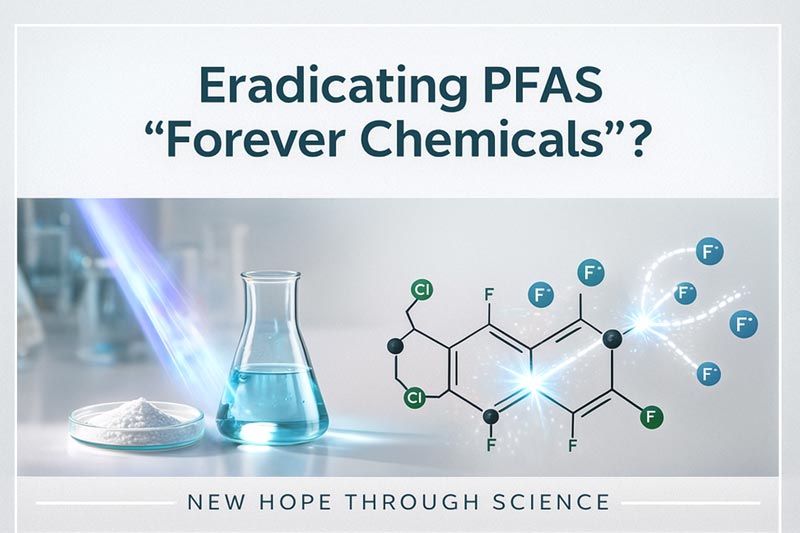
Eradicating PFAS “Forever Chemicals”? New Hope from UC Riverside
Eradicating PFAS forever chemicals: Scientists at the University of California, Riverside have made two important discoveries that could help break down PFAS, the “forever chemicals” found across our environment. These findings, published in the journal Nature Water, give researchers new hope that some PFAS may one day be destroyed safely instead of lasting for centuries.
Two Breakthroughs: Light + Sulfite, and Helpful Bacteria
1. Using Light and Sulfite to Break PFAS Apart
A research team led by Professor Jinyong Liu and graduate student Jinyu Gao studied a group of PFAS that contain chlorine atoms. They found that when these chemicals are exposed to ultraviolet (UV) light and sulfite, the chlorine-carbon bonds start to break. Once this happens, a chain reaction continues, breaking the strong carbon-to-carbon and carbon-to-fluorine bonds that make PFAS so hard to destroy.
This matters because PFAS pollution can only be safely cleaned up when those carbon-fluorine bonds are fully broken—a process called defluorination. Their method achieves almost complete defluorination in some chlorinated PFAS.
Even better, sulfite is inexpensive and easy to find. UV light is already widely used in water treatment plants. The process produces fluoride ions, the same safe form of fluoride added to many water systems for dental health.
2. Bacteria That Can Break Down PFAS
A second study from the same team discovered two types of bacteria that can break down certain chlorinated PFAS compounds. These bacteria work in anaerobic (oxygen-free) environments. They use a reaction called hydrolytic dichlorination, which removes chlorine atoms and starts the breakdown process. This leads to significant defluorination as well.
Together, these discoveries show real progress toward destroying PFAS instead of only filtering or containing them.
What Are PFAS?
PFAS (per- and polyfluoroalkyl substances) are human-made chemicals created in the 1940s. They became popular because they make products resistant to water, oil, stains, and heat. But PFAS don’t break down easily. This is why they’re called “forever chemicals.”
Where PFAS Are Found
PFAS have been used in:
-
Non-stick cookware
-
Fast-food wrappers and microwave popcorn bags
-
Outdoor gear and rain jackets
-
Stain-resistant carpets and furniture
-
Cleaning products and paints
-
Cosmetics (especially waterproof or long-lasting makeup)
-
Dental floss
-
Firefighting foams and firefighter gear
-
Some toilet paper and food packaging
Because they are used in so many products and do not break down, PFAS have spread into soil, air, rivers, lakes, drinking water, and even people’s bodies.
PFAS and Health Concerns
Government agencies and scientists have warned that even very small amounts of some PFAS in drinking water may be harmful. Studies have connected PFAS exposure to:
-
Higher risk of kidney and testicular cancer
-
Problems with cholesterol levels
-
Liver and immune system damage
-
Possible effects on fertility and development
PFAS have been found in the blood of both humans and animals around the world.
Government Actions to Reduce PFAS
The U.S. government has taken several steps to limit PFAS:
-
2016: The FDA banned certain PFAS in food packaging.
-
2020: PFAS makers agreed to phase out more types used in food packaging.
-
2021: The White House created a national plan involving the EPA, FDA, USDA, and others to reduce PFAS exposure.
-
2023–2024: The EPA proposed strict limits for PFAS in drinking water—the first national rules of their kind.
Many states have added their own PFAS bans or rules for drinking water, food packaging, and cosmetics.
Lawsuits and Cleanup Funds
Cities and towns across the U.S. have sued PFAS manufacturers for contaminating water supplies. This has led to large legal settlements:
-
3M agreed to pay $10.3 billion over 13 years to support water testing and cleanup.
-
Chemours, DuPont, and Corteva agreed to pay $1.9 billion for cleanup efforts.
These funds help communities test their water and remove PFAS.
PFAS in Drinking Water
A 2023 federal study found that up to 45% of U.S. tap water may contain PFAS. Bottled water has also been found to contain them in some cases.
To reduce PFAS in home drinking water:
-
Reverse osmosis filters work best and remove most PFAS.
-
Activated carbon filters can remove some PFAS but are less effective.
PFAS in Cosmetics and Firefighting Gear
The media has reported widely on PFAS in cosmetics such as makeup, shampoo, deodorant, and lotions. PFAS give cosmetics a long-lasting or glossy finish. Products labeled “waterproof,” “wear-resistant,” or “long-lasting” are most likely to contain them.
Firefighters face extra risk. Many firefighting foams and gear contain PFAS, which can expose them while they work.
PFAS in Fish and the Environment
Recent studies have found that many freshwater fish across U.S. rivers and lakes contain PFAS. This raises concerns about people who eat freshwater fish regularly and highlights why eradicating PFAS forever chemicals is so important to our daily lives.
Cork’s Commitment
Cork does not use PFOA, PFOS, or PFOS-related chemicals that could degrade into PFOA when making barrier coatings.
Why the New Research Matters
The goal is eradicating PFAS forever chemicals. PFAS have been extremely difficult to break apart. Until now, most cleanup solutions could only remove PFAS from water—not destroy them. The new discoveries from UC Riverside, using either UV light plus sulfite or special bacteria, offer real hope that PFAS can someday be broken down completely and safely removed from our environment.