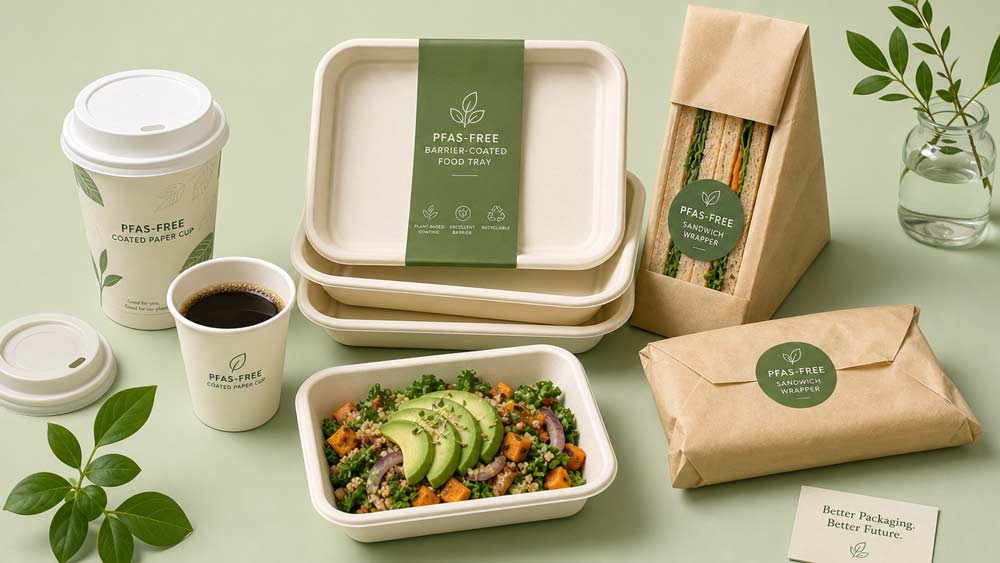
PFAS-Free Coatings Alternatives: The bans are law. The alternatives are ready.
Twenty U.S. states have enacted restrictions on PFAS in food packaging — [a regulatory wave](/pfas-packaging-phase-out-banned-chemical-compounds/) that continues to accelerate. The EU has set a hard cutoff of August 12, 2026 for fluorochemicals in paper and board food contact materials. For print shop owners, packaging converters, and coatings buyers, the question is no longer *whether* to switch — it is *what to switch to* and *how fast you can execute*. For the full regulatory backstory, see [FDA Bans Chemicals in Food Packaging Coatings](/fda-bans-chemicals-food-packaging-coatings/).
The good news: the market has moved decisively. The sustainable packaging coatings segment was valued at $15.80 billion in 2024 and is projected to reach $28.81 billion by 2032. That investment has produced a range of commercially available PFAS-free options that meet or exceed the barrier performance fluorochemicals have delivered for decades. This post walks you through what is on the shelf today.
What Made PFAS So Hard to Replace
Per- and polyfluoroalkyl substances became the default barrier chemistry for food packaging because they solved multiple problems at once. A single fluorochemical treatment could resist grease, oil, and moisture while remaining flexible enough for folding carton and paper substrates, thin enough not to affect machine runnability, and stable enough to survive heat and humidity across the supply chain.
That combination — grease resistance *plus* moisture resistance *plus* processability — is the engineering challenge every alternative has had to crack. Early replacement candidates addressed one dimension but fell short on others. Silicone-based coatings repelled moisture but offered poor KIT scores. Some bio-based dispersions showed strong grease resistance but failed repulpability tests. The industry spent several years iterating.
By late 2024 and into 2025, that iteration produced commercially scaled solutions across two broad technology tracks: water-based aqueous coatings and bio-based or compostable systems. Both tracks now have products that converters can order today.
—
The Four Performance Tests That Matter
Before evaluating specific products, every buyer needs a shared vocabulary for barrier performance. Four tests drive purchasing decisions in the food packaging market.
KIT Test (Grease Resistance)
The KIT test applies a series of increasingly aggressive castor oil/heptane/toluene solutions to a coated surface. Results are scored 1–12, with 12 indicating maximum grease resistance. Food-contact applications for QSR wrappers and clamshells typically require a KIT score of at least 10–12.
WVTR (Water Vapor Transmission Rate)
Measured in grams per square meter per day (g/m²/day), WVTR tells you how much moisture passes through the coated substrate under controlled temperature and humidity. Lower numbers mean better moisture protection. Cold and frozen food applications are especially sensitive to WVTR.
Heat Sealability
Food packaging lines run fast. A coating must be compatible with heat sealing equipment — meaning it melts and bonds cleanly at press temperatures without delaminating, blocking, or contaminating adjacent surfaces. Not all bio-based dispersions achieve this without reformulation.
Repulpability
At end of life, coated paper and board must be recoverable through standard recycling streams. A repulpable coating disperses cleanly in hot water pulping cycles and does not leave fiber-contaminating residue. Mills and brand owners increasingly require third-party repulpability certification.
How to Evaluate and Switch
Start With Your Performance Envelope
Map every SKU against the four tests above: required KIT score, WVTR target, heat seal compatibility, and repulpability requirement. Not every product in your portfolio needs a KIT 12 coating. Many bakery and dry goods applications can be served with lighter barrier systems, which opens up lower-cost options.
Sequence Your Trials Strategically
Drop-in aqueous replacements are the logical starting point for converters needing to move fast. They minimize press modifications and shorten the qualification timeline. Bio-based systems involve longer trials because extrusion line parameters and end-of-life certification work run in parallel.
Nail Down FDA Status Before Sampling
Every coating in direct food contact requires FDA clearance under 21 CFR. Confirm that your supplier has existing food contact compliance documentation, and verify that the specific coat weight and substrate combination you intend to run falls within the scope of that clearance. Do not assume a coating approved for one application covers yours.
Build Your Repulpability File Now
As paper mills tighten incoming material specifications, converters are increasingly being asked to provide repulpability test data at the coating and substrate level. Begin accumulating that documentation — TAPPI T 205 or equivalent — during your trials so it is available when a customer or mill requires it.
Lock in Lead Times
PFAS-free coating capacity is being absorbed quickly. Several suppliers are already reporting extended lead times into late 2026. Do not wait for a customer to mandate the switch before placing qualification orders.
Cork Industries Can Help You Navigate the Transition
Cork Industries has spent decades at the intersection of barrier science, food packaging compliance, and press-room performance. We understand that a coating change is not just a chemistry decision — it touches procurement, press operations, quality systems, and customer communication simultaneously.
If you are evaluating PFAS-free alternatives for your substrate and application mix, our technical team can help you match performance requirements to the right product, structure your trial plan, and work through the FDA documentation your customers will need.
Contact Cork Industries to discuss your transition to a PFAS-free coating.