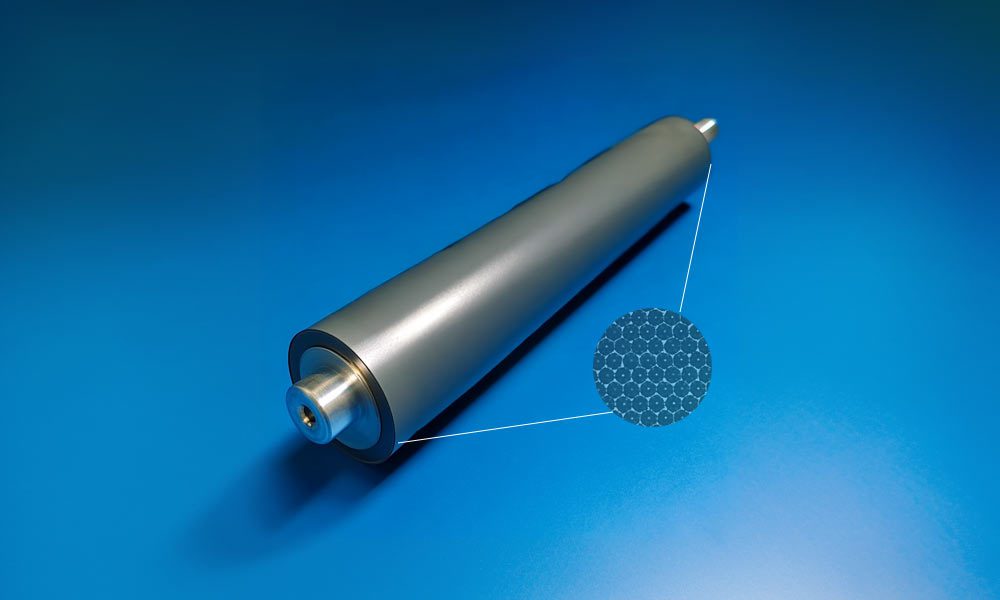
Anilox Roller Cleaning
Maintaining anilox roller cleanliness is critical to ensuring the precise and consistent delivery of inks, coatings, varnishes, and adhesives to substrates in various printing and coating applications. As a precision-engineered metering roller, the anilox roller plays a key role in achieving uniform liquid transfer, making it essential to implement an effective anilox cleaning and maintenance program.
Proper cleaning not only enhances print quality and operational efficiency, but also extends the lifespan of the anilox roller, ensuring reliable and reproducible results with every run.
Planned Anilox Roller Maintenance
- Wiping anilox rollers clean using an appropriate cleaner as soon as a job is finished.
- Keeping the roll turning to prevent drying in cells, whenever there is anilox exposure to a liquid in the application system.
- Covering the anilox roller, limiting flowing air exposure.
CORK-CLEAN™ UV Blanket, Roller Wash, and System Flusher
It’s essential to remember that the difficulty of cleaning increases rapidly as an applied liquid is allowed to dry or cure in the cells of an anilox roller.
In terms of dealing with fast, effective, and safe clean-up of UV inks and coatings, CORK-CLEAN™ UV blanket, roller wash, and system flusher is recommended as proven to be effective as an equipment, blanket, roller, and anilox wash for all commercial UV inks and coatings.
CORK-CLEAN™ is a safe aqueous-based wash-up that is low odor (lemony), low in toxicity, and is nonflammable with a flash point higher than 199.4 F./93 C. It is formulated to uniquely react chemically with UV inks, and coatings to disperse them as discreet emulsified particles that are stabilized in the water carrier.
This action effectively allows the total removal of UV inks, and coatings from rollers, and out of anilox cells leaving the surfaces residue-free after flushing, rinsing, and drying.
Solvent-Based Cleaners May Leave Residue
Competing, there are, many solvent-based UV press wash products. These are typically high in odor, highly flammable with low flash points (e.g., 145° F) making them hazardous to use, and have very high VOC content ranging from 50% to 78% plus. These work by dissolving UV inks and coatings leaving a residue on cleaned surfaces.
The preferable option for cleaning UV using anilox and ancillary equipment, is CORK-CLEAN™ equipment, blanket, roller and anilox wash for all commercially used UV inks and coatings. Specific to anilox rolls, CORK-CLEAN™ effectively cleans and restores the volume of ink-clogged cells.
Anilox Roller Cell Size is Critical
Critical to anilox roll cleaning is an understanding of actual cell size. Keep in mind that, the opening of an anilox cell is only a fraction of the diameter of a 100-μ wide human hair. The cell opening on a 600 cpi anilox roll is 38-μ, and the opening on a 1,200 cpi anilox roll is 18-μ. Plugging these tiny cells doesn’t take much. It’s a challenge to reach or see the bottom of these tiny anilox cells.
To prove that an anilox roll is truly clean a microscope is required. Looking at a clean cell will reveal a centrally located white dot, which is light reflecting from the cell bottom. If this white dot is not seen, the bottom of the cell remains plugged with whatever liquids have been in use, inks, coatings, etc.
Anilox Roller Cleaning Techniques
Anilox rolls that are used with water, solvent, and oil-based inks, which dry when left sitting out and unagitated, must be cleaned immediately after use or the problem known as plugging occurs, where minuscule amounts of ink dry in the cells. This leaves tiny, but unacceptable, pinholes in anything printed from the roll, in the future.
A stainless-steel brush, should be used with a circular motion on ceramic rolls, and a brass brush on chrome rolls. Brush wire can be as small as .003 in dia. and as such is larger than a cell opening, however it is turbulence that cleans, not the wire reaching down into a cell.
The key to effective cleaning of anilox rolls that are used with water, solvent and oil-based inks is to use a non-corrosive cleaner. Don’t overlook the cleaning of the ends of an anilox roll. Essential to good cleaning is rinsing and drying.
Thorough rinsing will remove any leftover cleaner, eliminating any possible corrosive damage. A 50/50 isopropyl alcohol and water mix is recommended. Be sure to only store a completely dry anilox roll.
Five steps to good cleaning are as follows:
- Clean thoroughly with a recommended cleaner
- Rinse
- Rinse
- Rinse
- Dry thoroughly
A wide variety of anilox cleaning solutions are available to use to keep rollers clean between “major cleanings”. Recommended by Flexo Exchange are “Harper Scientific’s Ceram Clean II” and” Strong and Safe Ani Gel by Flexo Cleaners”.
Popular Major Cleaning Methods for Anilox Rollers
Baking Soda (Sodium Bicarbonate) Blast:
This cleaning method uses air pressure 20-35 psi for chrome and mechanically engraved anilox, and 30-35 psi for laser engraved ceramic anilox to blast baking soda media onto the target roll. Impacting the roll, large soda crystals hit and fracture breaking into smaller crystalline pieces.
These then can reach inside cells and remove dried ink, coatings, etc. This method can be used on both wide and narrow web anilox rolls, working best on chrome and ceramic. Wide web rolls can be cleaned either on or off-press, and narrow web rolls off-press only.
Plastic (poly) Bead Blast:
This cleaning method, similar to baking soda blast, uses air pressure at 35-70 psi and plastic bead media to blast an anilox roll. Generally cleaning is conducted in an off-line enclosed cabinet, where the roll is rotated as a bead spraying nozzle traverses the length of the roll. The small plastic beads are able to get down inside of the cells to break up dried inks, coatings, etc. Cleaning cells is fast, and effective.
Ultrasonic Cleaning:
This cleaning method uses ultrasonic waves to cause cavitation in a liquid. The cavitation creates a cleaning action in a cleaning solution that an anilox is submerged in. Overexposure in terms of cleaning time can cause damage to cells, and must be carefully monitored. Higher line screen anilox require shorter cleaning times, and are vulnerable to damage.
Maintaining anilox roll cleanliness is essential for achieving consistent, high-quality results in printing and coating applications. By following a regular cleaning and maintenance routine, businesses can extend the lifespan of their anilox rolls, reduce downtime, and ensure accurate liquid transfer with every use. Investing in proper care not only improves efficiency but also helps maintain product quality and customer satisfaction. Prioritizing anilox roll maintenance is a smart choice for long-term success.
Corks’ business is the development and formulation of Aqueous, energy-curing Ultraviolet (UV), and Electron Beam (EB) specialty coatings and adhesives.